
Seyfeddin Aliyev:
The Khojaly tragedy and the return to Khojaly: An unforgettable history
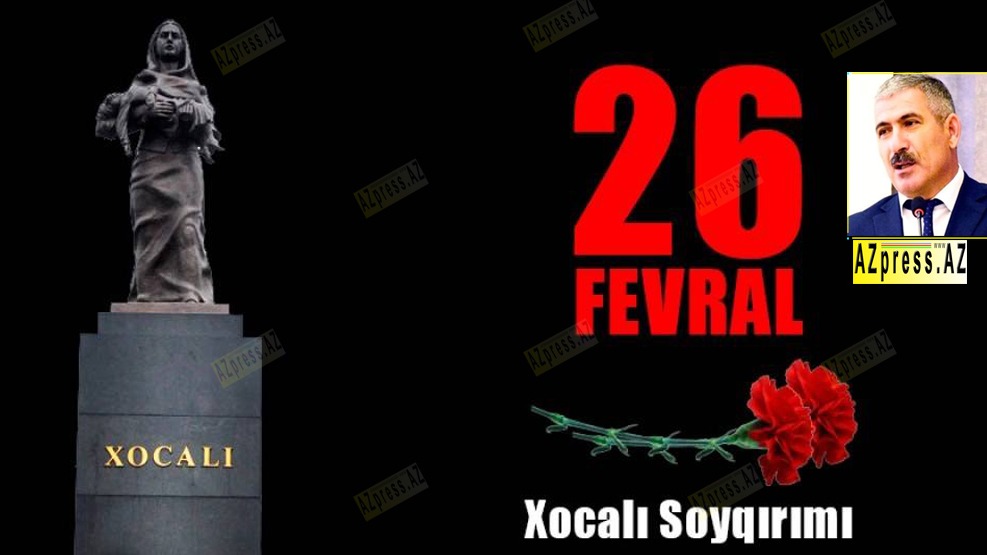
At the end of 1991 and the beginning of 1992, the Armenian-Azerbaijani conflict entered the military stage. Taking advantage of the political instability caused by the disintegration of the Soviet Union and internal strife in Azerbaijan, Armenia started military operations in Nagorno-Karabakh using foreign military aid. In February 1992, an unprecedented genocide was committed against the population of Azerbaijan in the city of Khojaly. In this bloody tragedy, known as the Khojaly genocide, thousands of Azerbaijanis were massacred or captured, and the city was razed to the ground. On the night of February 25-26, 1992, the Armenian armed forces, with the help of the 366th infantry regiment of the former USSR, invaded Khojaly, a small city located in the Nagorno-Karabakh region of the Republic of Azerbaijan, which had a population of 23,757 people and a total area of 0.94 square kilometers before the conflict. Before the start of the terrible night, the residents of Khojaly (about 2500 people) who remained in the city tried to leave their homes after the attack started, hoping to find the way to the nearest areas inhabited by Azerbaijanis. These plans also failed. The invaders destroyed Khojaly and massacred the civilian population with particular cruelty. The brutal extermination of hundreds of innocent residents of Khojaly was one of the most heinous crimes during the armed conflict in and around the Nagorno-Karabakh region of the Republic of Azerbaijan. Armenian armed forces and foreign military units did not spare any people who could not escape from Khojaly and surrounding areas. As a result, 613 people including 106 women, 63 children and 70-year-old people were killed. 1,275 residents were taken hostage, and the fate of 150 people is still unknown. During the tragedy, 487 residents of Khojaly were seriously maimed, and 76 of them were children who had not yet reached the age of majority. 6 families were completely destroyed, 26 children lost both parents and 130 children lost one parent. 56 of the murdered people were killed with special cruelty - they were burned alive, scalped, their necks were shot, their eyes were gouged out, and pregnant women were killed with bayonets in the abdominal cavity.
The city of Khojaly, distinguished by its historical monuments, having an ancient culture and strategic importance, which is of great importance in the study of the history of Azerbaijan, literally became a ruin as a result of the occupation. As a result of the terrible inhumane acts of the Armenians, 105 social and household objects, 3200 private residential buildings, 14 schools, 21 clubs, 29 libraries, three culture houses and one history-local history museum were destroyed in the city of Khojaly. In addition, the tombs, domes, and tombs of the XIV-XV centuries in the city were razed to the ground, the cemetery was destroyed by vandal methods, and in general, all traces of the Azerbaijanis, the oldest inhabitants of this land, were erased.
The Khojaly massacre is a bitter example of the inconceivable atrocities of the Armenian fascists in the history of the Azerbaijani people. National leader of Azerbaijan Heydar Aliyev said in his address to the people of Azerbaijan on the occasion of the tenth anniversary of the Khojaly genocide: "This merciless and cruel act of genocide has entered the history of mankind as one of the most terrible acts of mass terrorism".
The Great Leader Heydar Aliyev, who has repeatedly stated that the Khojaly tragedy is the blood memory of the Azerbaijani people, emphasized the need to give a real political assessment to the events in the international world, and made a special effort to convey this issue to the world community. On the initiative of Great Leader Heydar Aliyev, on February 24, 1994, the Milli Majlis adopted a decision "On Khojaly Genocide Day". Our national leader, who called this tragedy a great pain, sadness, grief of our people, at the same time, valued the struggle of our people for centuries, the path of national liberation as a glorious and successful path. With the order of Great Leader Heydar Aliyev dated February 25, 1997, in order to commemorate the victims of the Khojaly genocide, a minute of silence was announced every year on February 26 at 17.00 in the territory of the Republic of Azerbaijan as a sign of respect to the victims of the Khojaly genocide.
A number of important measures have been implemented by our state to perpetuate the memory of Khojaly martyrs. The Khojaly genocide was recognized by a number of countries and the tragedy was given an international political evaluation. As a result of the systematic work carried out to promote the Khojaly genocide on a world scale, the Khojaly genocide was recognized and remembered in parliamentary acts adopted in many countries. So far, relevant parliamentary resolutions have been adopted by the legislatures of Bosnia and Herzegovina, Colombia, the Czech Republic, Honduras, Jordan, Mexico, Pakistan, Panama, Peru, Sudan, Djibouti, Guatemala, Paraguay, Slovenia, Scotland, Indonesia and Afghanistan. The Khojaly genocide has been recognized by more than 30 US state parliaments and gubernatorial proclamations. In the Final Communiqué adopted at the 12th session of the OIC Islamic Summit Conference held in Cairo in February 2013, the member states are called to make necessary efforts towards the recognition of the Khojaly genocide. In its decision dated April 22, 2010, the European Court of Human Rights defined the massacre of the Azerbaijani civilian population of Khojaly as "particularly grave acts that can be considered as war crimes or crimes against humanity".
We are no longer citizens of the Republic of Azerbaijan 34 years ago. We are citizens of a free, independent, democratic, secular, unitary, sovereign, legal state. As a result of the wise policy of President Ilham Aliyev, we are also the victorious residents of a victorious country. With the 44-day Patriotic War, the heroic Azerbaijani Army proved to the whole world that Khojaly is one of our sacred historical homelands. Thanks to the determination of the victorious Commander-in-Chief Ilham Aliyev and the bravery of our army, the native Khojaly was sufficiently avenged.
Today, thanks to the tireless work of President Ilham Aliyev and First Vice-President Mehriban Aliyeva, Khojaly is being rebuilt, just like our villages and homelands, which were freed from occupation.
Currently, life is boiling again in Khojaly. The faces of the people who returned to our homelands that were freed from occupation and live there show joy, confidence and happiness in their eyes. The fact that President Ilham Aliyev met with our compatriots who returned to their native homes in Khojaly region and had a sincere conversation is an example of our head of state's love for the people of Khojaly. The meeting of our President with them, drinking tea at a table increases the confidence of our citizens in their leader and raises the determination to build and create in the lands freed from occupation.
The Khojaly tragedy and the return to Khojaly is an unforgettable history.
Our regions and villages, freed from the 30-year-old Armenian occupation, are being reconstructed from start to finish and are gradually being handed over to the residents. Our people will remember the tragedy of Khojaly in the coming years, just like everywhere else in our republic, also in Khojaly.