
108 years have passed since the Armenian genocide against Azerbaijanis
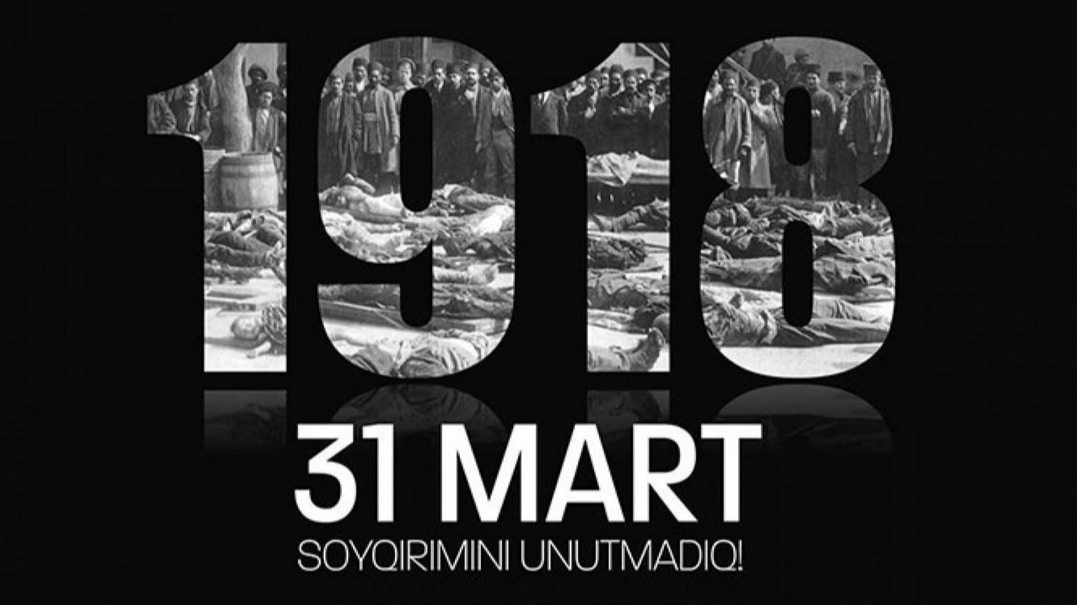
March 31 is the 108th anniversary of the genocide - the first large-scale ethnic cleansing carried out by Armenians against the people of Azerbaijan.
Tens of thousands of our peaceful compatriots were killed during this terror carried out with the support of the Bolsheviks.
On March 31, 1918, a massacre against Azerbaijanis began in Baku. According to official sources, in the genocide that lasted until April 3, tens of thousands of Azerbaijanis were killed in the city of Baku and in various settlements of the Baku governorate, as well as in Karabakh, Nakhchivan, Shamakhi, Guba, Khachmaz, Lankaran, Salyan, Zangezur and other regions, especially with the participation of Baku Soviet troops and armed Armenian Dashnak units.
Small settlements, historical monuments, mosques and cemeteries were also destroyed. Six thousand soldiers of the Baku Soviet, as well as four thousand armed detachments of the Dashnaktsutyun party participated in the massacre of the Azerbaijani civilian population.
A German named Kulner, who witnessed these terrible days, wrote about the events in Baku in 1925: "The Armenians broke into the Muslim (Azerbaijani) neighborhoods and killed everyone, wounded them with swords and stabbed them with bayonets. A few days after the massacre, the bodies of 87 people who were taken out of the ravine had their ears and noses cut off, their bellies torn and genitals were cut off. Armenians spared neither children nor the elderly."
After the establishment of the Azerbaijan Democratic Republic (ADR), special attention was paid to the investigation of the events of March 1918. For this purpose, the GDR government created an Extraordinary Investigation Commission on July 15.
According to his materials, Armenian bandits killed up to 8,000 civilians in Shamakhi, completely destroyed 28 villages in Javanshir, and 17 villages in Jabrayil regions and subjected the population to massacre. An Azerbaijani caravan of 3,000 people, consisting mainly of women, children and the elderly, was ambushed near Gyumri - everyone was killed.
Armenian armed groups burned several villages in Nakhchivan district, destroyed 115 Azerbaijani villages in Zangezur district, killed 3257 men, 2276 women and 2196 children. In total, 10,068 people were killed or maimed, and 50,000 people became refugees.
135,000 compatriots living in 199 villages of Iravan province were killed, and their settlements were destroyed. After that, Armenian groups moved to Karabakh between 1918 and 1920 and destroyed 150 villages in the mountainous region and completely destroyed their population.
British Brigadier General V.A. Gorton's report to London dated December 8, 1918 stated that 20,000 Muslims were victims of the genocide. 30,000 are indicated in the materials of the Extraordinary Investigation Commission of the Azerbaijan Democratic Republic (ADR), and 50,000 in the book published by the Milli Majlis. It is even possible that this is not all.
The head of the Azerbaijani delegation at the Paris Peace Conference, Alimardan Topchubashov, in his address to US President Woodrow Wilson on May 28, 1919, presented him with the materials of the Extraordinary Commission of Inquiry, along with other documents. After that, it was considered appropriate to send a US delegation to the South Caucasus to collect objective information. That summer, General J. Harbord, who came to Baku for this purpose, met with various people.
At that time, Russian and Armenian organizations operating in Baku obstructed the normal work of the Extraordinary Investigative Commission and organized pressure campaigns. However, despite all the difficulties, he managed to do a lot of work in a short time.
Stepan Shaumyan, the direct organizer of these tragic events, did everything he could to justify his actions. He wrote in a letter sent to the Council of People's Commissars in Moscow that the Armenians allegedly killed Azerbaijanis not because of ethnic hatred, but because of loyalty to the Soviet authorities.
March 31 was celebrated as a day of national mourning in the Azerbaijan Democratic Republic in 1919 and 1920.
At the initiative of the national leader Heydar Aliyev, the investigation of the events of the March 31 genocide and the informing of the international community about the facts of this terrible tragedy have been started.
March 31, 1918 was declared the Day of the Genocide of Azerbaijanis by the Decree "On the Genocide of Azerbaijanis" signed by Heydar Aliyev on March 26, 1998 and of great historical importance. Since then, significant work has been done to study the tragic events, and numerous books dedicated to the genocide have been written and translated into foreign languages.
Thanks to the research conducted in this field in recent years, a large number of new facts and documents have been collected. The mass grave discovered in Guba is one of the bloody episodes of this tragedy.